|
 |
|
Washington
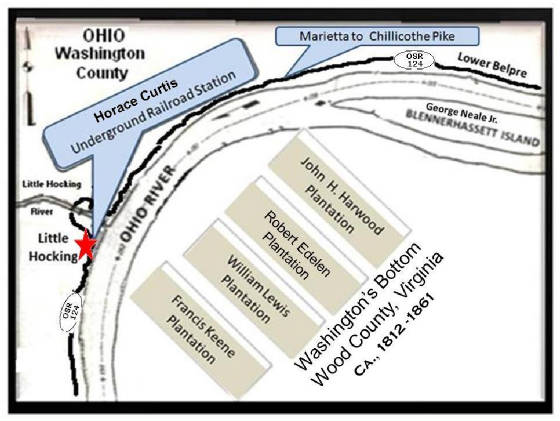
Bottom, is directly across he Ohio River from first Underground Railroad Station on the Ohio River. Slaves from Washington
Bottom began to run away early on and some continued to run away right up until the Civil War began.
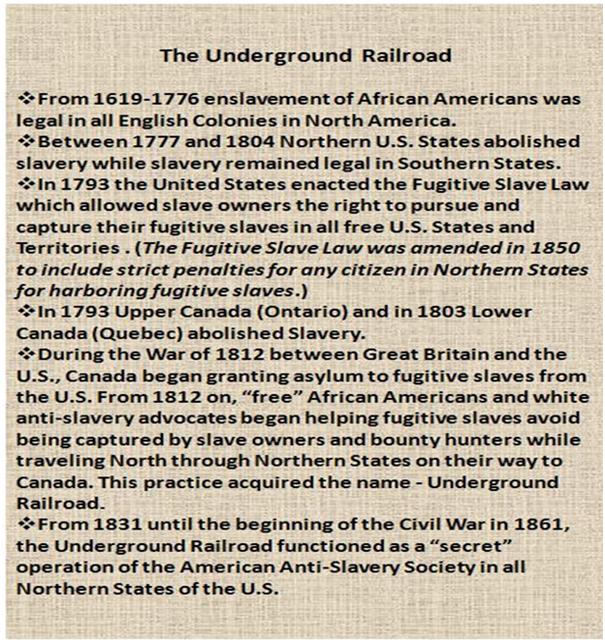
1812 is the year the Underground
Railroad began to operate. The British government sent agents into the United States and offered enslaved African Americans
asylum in Canada if they could mange to get there. Getting to Canada from the
‘slave states” was not an easy proposition for the average enslaved person in 1812, so it does not appear that
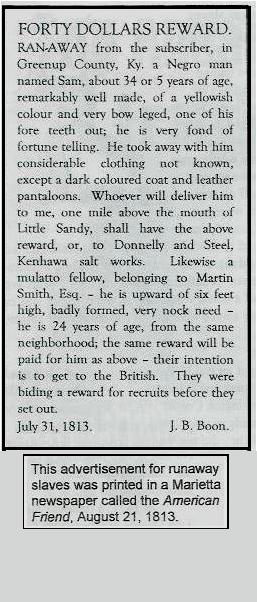
a flood gate was opened up at that early date. This was however when some bold young enslaved African Americans began to run
away to Canada and here is the best evidence so far for when the history of the activity the known as the Underground Railroad
began along the Ohio River.
In regard to the Fugitive Slave Law of 1793, and the stronger penalties added in 1850, it soon became apparent to enslaved
African Americans and anti-slavery advocates that fugitive slaves would need a great deal of help to avoid being captured
by their slave owners of bounty hunters while traveling across the states of the United States to reach the Canadian Border.
This was the rationale for establishing the Underground Railroad, but the Underground Railroad did not just appear one day
and fugitive slaves just jumped aboard and rode to Canada.
The first fugitive slaves to run off to Canada were young, healthy and probably had a little extra awareness of geography
to help guide them to Canada. They also had help from a group of people called Melungeons, a term that will be fully explained
as this book progresses. As time progressed into the 1820s, help from a growing number of anti-slavery advocates, living mostly
in the “Northern States” where slavery was illegal, were beginning to significantly increase the success rate
for fugitive slaves to reach Canada.
During the 1830s the Underground Railroad became a covert wing of the American Anti-Slavery Society and its affiliated chapters railroad terminology came into use by the Underground Railroad operators.
to c on in secret and, because railway terms were used to disguise the real nature of the operation fugitive slaves were called
“Passengers”; routes were called "Lines"; stopping places where the fugitive slaves rested were called "Stations";
and those who helped fugitive slaves find their way north were loosely called "Conductors"; almost everyone else involved
with helping on the Underground Railroad were called “Agents”.
An article appearing in the Marietta
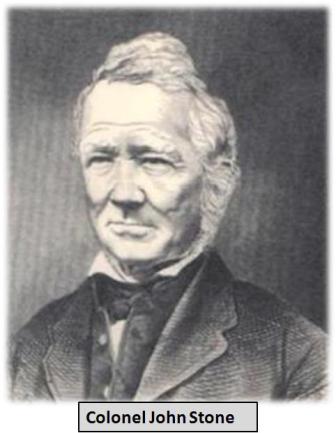
Weekly (Newspaper) on March 9, 1886 and signed simply, "M.L.H.", gives us much information about the local Underground Railroad. The writer cites his source as Col. John ("Jack") Stone of Belpre who lived to the
age of 90. John Stone was born in Belpre, Washington County, Ohio on June 23,
1793. He was the son of Jonathan Stone, who served as a Captain in the American Revolutionary War and Charlotte Putnam Loring,
from a prominent New England family. The Stones were among the earliest American settlers in Ohio.
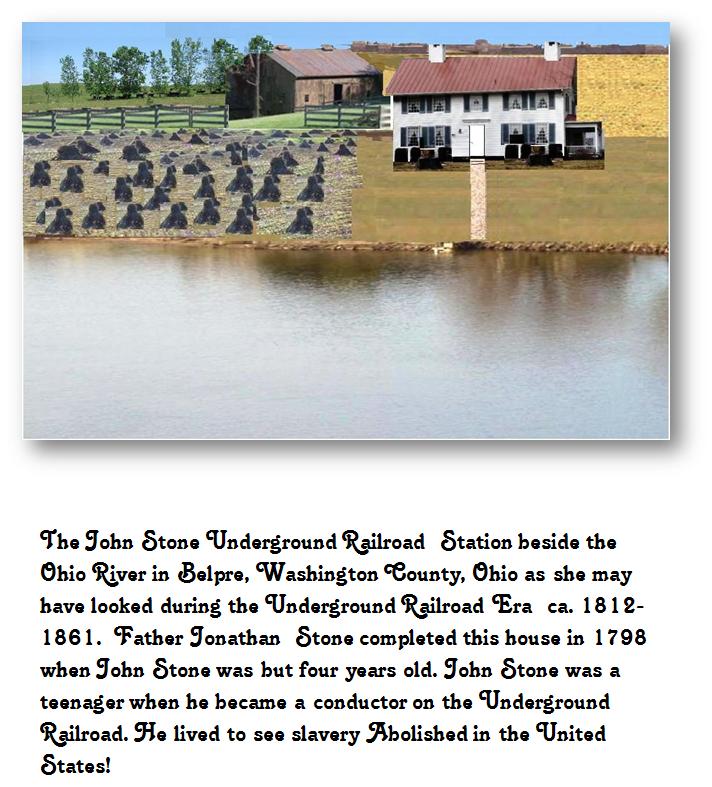
John Stone was born in the house his father had built that originally stood right on the Ohio River. Because of floods
thirty-eight yoke of oxen were brought in to move the house some 400 yards back from the Ohio River to its present location.
The moving of this house was one of the memorable events during early times in Belpre.
In 1826 John Stone was made Colonel of the Ohio Militia and was known as Colonel Stone ever after. Col. Stone was born and grew up in Ohio on the north bank of the Ohio River where slavery was illegal and
across on the south side of the Ohio River in Virginia, slavery was legal. John
Stone had a lifelong interest and participation in anti-slavery activities and the Underground Railroad. It must be noted
that Col. Stone lived through the entire saga of the Underground Railroad and saw
the end of the legal enslavement of African Americans. It is hard for me to imagine a more creditable source for Underground
Railroad History along the Ohio River.
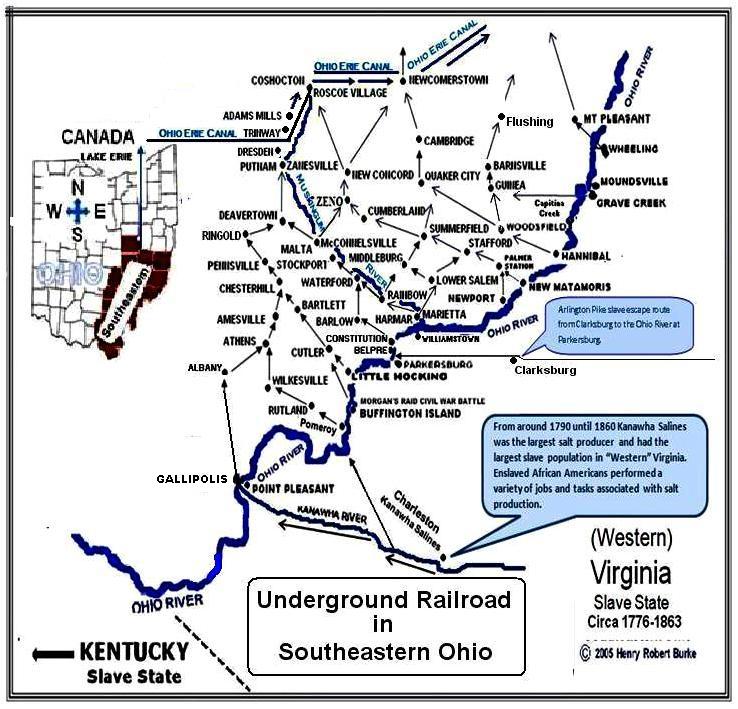
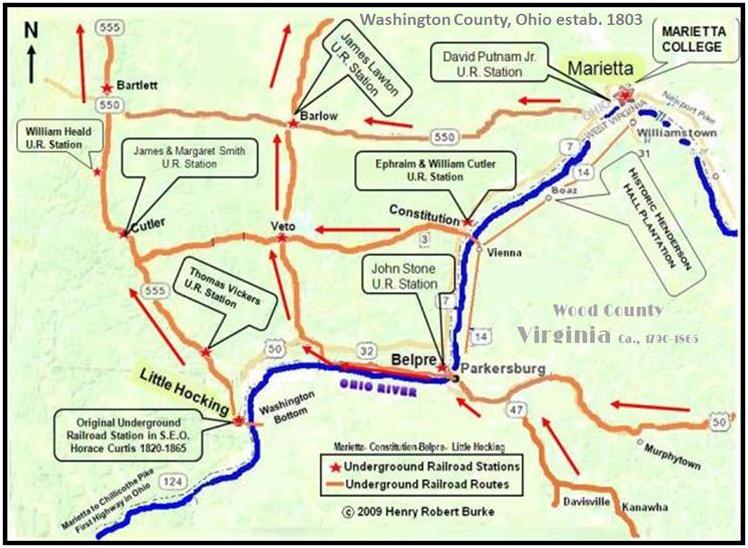
Col. Stone identified the Horace Curtis house as the first station on the Underground Railroad, in Ohio. Stone gives a geographically accurate location of the Curtis house.
He stated that it was about 20 miles below Marietta and about four miles south of Blennerhassett Island. He stated that he had observed the house from Mt. Observation hill (known locally as, "Bartlett Hill."),
which was 300 yards back from the Ohio River, directly across from Washington's bottom lands, and the house he described,
was located south of the railroad and about 300 yards from the foot of Mt. Observation.
Any good surveyor could accurately locate the house that Stone describe as Sawyer/Curtis House.
Here is an account of Stone’s testimony. After describing the Virginia
bottom lands directly opposite Little Hocking, Ohio, M.L.H. states, "An ordinary country road, leading to Athens, O., has
been cut around the south side of "Mt. Observation" hill and just below this hill runs the Cincinnati, Washington & Baltimore
railroad, one of the main branches of the Baltimore & Ohio railroad. . . . Just south of this railroad, and perhaps a
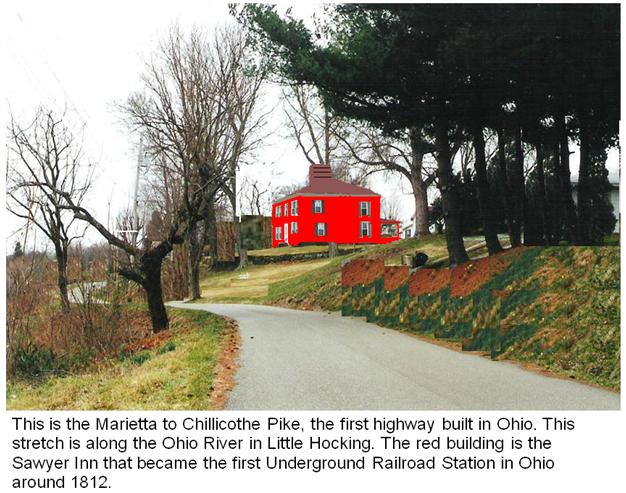
hundred yards from the foot of the hill mentioned, are the ruins of an old two story frame dwelling house, painted red, and
a small barn, which was always well filled with hay and straw. In ante bellum days the tenants of this place were comparatively little known in the
community. In fact they were Melungeons who were very well suited to carrying on the work of the Underground Railroad. Melungeons
would move in, stay a short time, and depart; soon another family of Melungeons from unknown places would take possession,
stay awhile, and then move on as their predecessors had. Such changes were frequent. The fact was, these tenants were engaged in what was unlawful work of helping slaves
run off from their masters and helping enslaved Negroes reach southeastern Ohio. The
tenants were wise in not making acquaintances, and in not staying very long in that place, for it had it become known around
what occupation they followed, they would have found that river-side residence a very unhealthy.
"It was a long time before white persons, except those engaged in the work, suspected the character of the place, but
the Negroes just across the Ohio River, through some subtle means, had learned much concerning it, and often looked toward
the spot with longing yet cautious eyes. Hundreds of Negroes living many miles
away had heard of its existence. It was the first "Underground Railway" established
in Ohio." He filed his first application for
a tavern license in 1799 and operated it as such until he sold the house in 1806. "Public
houses" were uniformly painted red, as red lead paint was the cheapest available and, to set them apart from "private houses." The house, as Stone remembered it, was described as a "ruin," and a look at its history
tells why. Sawyer sold it to Reuben Allen who, having greater plans, sold it
to William Browning and Timothy Buell, in 1817. The new owners rented it to different
parties. Without doubt it was the Melungeons who moved in and out as Col. Stone reported.
The house and 75 acres were later sold to Horace Curtis, in 1820. He did
not move into the house until September of 1825, hence the house was rented and went without repairs or paint for a period
of 19 years. This accounts for Col. Stone's description of the house, as a "ruin." Col. Stone's remarks about the sinister people who came and went before 1825 indicate
that the renters were highly involved in antislavery activities, also. These
Melungeons may have been persons well known to Horace Curtis. The strategic location of the Curtis house made it ideal for
antislavery activity. Some escapees traveled the road from Alexandria, Virginia,
to the mouth of the Little Kanawha River at Parkersburg, Virginia. The Northwestern
Pike was the most extensively used roads for stage coaches and freight wagons traveling east to west and visa versa during
that period. From Parkersburg they needed only to find passage across the Ohio
River to Belpre. Once across the river they could travel the old Marietta to
Chillicothe Pike.
Built in 1792, It was the first road commissioned in the Northwest Territory. The Sawyer house was prominently located on this road at Little Hocking. Though there was a wharf boat at the mouth of the Little Hocking River there was a fine river landing in
front of the Curtis house. Here, packet boats with merchandise for the Curtis
store and mail boats landed frequently. Facing the Ohio River at mile 192, it
made an ideal place for slaves to be set off on the Ohio shore without suspicion. This
landing was also a popular stop for show boats.
M.L.H.'s article continues: "Many Negroes succeeded in reaching the Ohio shores despite the watchfulness of their masters. Usually they cross the Ohio River by night and down by the somewhat secluded Underground
Railroad Station, now in ruins (the Curtis house).
Once over, they cautiously made their way to the Station, where in some manner, they made the Agent aware of their
presence. If it were not too near morning they were conducted at once out to
Thomas Vicker’s Station. In other cases they were put under hay or straw
in the barn, or taken to some caves which were in the not too distant woods and kept there, being fed from the agent's table
until an opportunity came to move on. When building the B & O short line
railway through Little Hocking, caves were found on the hillsides behind the Curtis house.
By the time of the Civil War, the Underground Railroad extended throughout the Northern States but the most intense activities had taken place in Southeastern Ohio where fugitive slaves had been helped
from one Station north to the next Station north until they safely reached Canada.
Those who were most active in helping slaves to escape by way of the Underground Railroad were called "Abolitionists." Churches from most Christian denominations in the North were active with the Underground
Railroad.
The railroad evolved locally into an extensive network as the settlements in the mid-Ohio River Valley, on opposite
sides of the river, polarized into proslavery and antislavery factions. It is
easy to track tracks some of the by-roads of Washington Count that were used by the Underground Railroad. Between Belpre and Little Hocking individual efforts were being made to free slaves, from the beginning
of the 19th century. Public forums were held in Washington County in the 1830's
and stirred much antislavery support. Societies were formed and public meetings
often ended in mob violence. Those who sought freedom for Negroes were labeled
with contempt as, "lick spittle."
The fertile bottoms across the Ohio River from upper, middle and
lower Belpre, were "free state" and that caused much turmoil and unrest in the communities on the South side of the river. Virginia slaves were always trying to slip away to Ohio to become free men. They knew Ohio was "free soil," but they had to have freedom papers or they would be apprehended and taken
back to Virginia . A look at Ohio law will reveal that even “free”
blacks entering the state had to register county clerks and keep their freedom papers on their persons at all times. Free blacks had to post bonds of $500 within 20 days of entering the state, to ensure
their good behavior. Blacks could own property in Ohio, but could not vote. No black or mulatto person was eligible to hold public office or serve on military
duty. They could not give testimony in any court of law, if either party was
white or in any case where the state made the charges. So "free soil" of Ohio
actually meant that a Negro had few rights and was deprived of securing justice
through the courts. But all that said, life for a Negro in Ohio was better than
slavery in the South.
As friction mounted on both sides of the river, Virginia plantation owners formed armed gangs of men called "Home Guards." These groups patrolled the river landings late at night to watch for fleeing slaves. In the early 1800's hundreds of Virginia slaves lived and died in sight of the "land
of freedom," across "The River Jordan," as they called the Ohio River. Not all
died in slavery as the records show, but were aided by sympathetic Ohioans. Once
across the river the fugitives were guided through the dark ravines and deep recesses by day, and hidden in caves and caverns
along the Little Hocking River, by night. They were secreted in false bottom
wagons and passed from station to station, where another secret friend waited to guide them on. In spite of the difficulties of moving slaves to freedom, it is estimated that from 1800 until the War
of Rebellion, about 1200 fugitives found their way to liberty, via local "Conductors."
Historic records show that abolitionists were active in Marietta, Constitution, Belpre and Little Hocking.
The Melungeon sub-culture began to develop
early in the Appalachian Mountains during the English Colonial Period of American History. It is very similar to the mountain
sub-cultures established by the Scotts-Irish settlers in Appalachia, but the Melungeon sub-culture was in Appalachia first.
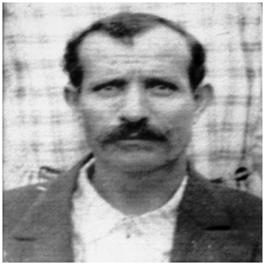
In the photo is Jacob Dalton, who typifies Melungeons in southeastern Ohio during the Underground Railroad Era. Melungeons are usually tall people with
straight black hair and generally have European features. Melungeons typically look like well tanned white people. Now that
DNA analysis is establishing who Melungeons really are. Melungeons had a big role in creating and operating the Underground
Railroad that assisted thousands of enslaved African Americans to travel safely across Southeastern Ohio on their way to freedom
in Canada During
the Slavery Era, the mobility of black people in the United States was very limited.
Laws were enacted not only to protect slave owners from loss of their human property, but to prevent slave insurrections.
While there always a few free blacks, they were, for the most part ineffectual in moving about freely. Black people could
easily be identified and restricted because of their dark skin and Negro features. Across the entire United States, there
were countless local, state and/or federal laws that restricted the movements and activities Negroes slave or free. This made
it impossible for people with black skin to travel freely to establish and maintain the crucial elements necessary to operate
the Underground Railroad. Melungeons are a little known ethnic group of people who have been in the United States since early
Colonial Period. Very simply put, Melungeon genealogy is made from white indentured servant mothers and [1]black fathers, either slave of free. A whole bunch of confusing laws contributed to creating conditions whereby
Melungeons were attached to African Americans, but in some cases could not be identified visually as African Americans.
Melungeons were the backbone of the Underground Railroad. According
to custom Melungeons were considered “black” but many Melungeons could easily pass as white if their genealogy
were not known. Unlike dark skinned Negroes they could travel anyplace in the United States. For this reason Melungeons provided
the critical link between enslaved African Americans and the Underground Railroad. Legalizing the enslavement of black people
from Africa had begun in Massachusetts in 1640 and in Virginia around 1661, but it took until 1700 before Africans more or
less replaced indentured servants as the main source of labor on tobacco plantations in Maryland, Virginia, and North Carolina.
Before that time many Gypsy people had been purposely rounded up, arrested all over Europe, the transported to the English
Colonies and sold as indentured laborers on tobacco plantations. Understanding how Indenture was applied during that period
will help explain how indenture worked. A short explanation is that there were craftsmen and even a few professional people
who voluntarily indentured themselves for passage to America. There were also the involuntary indentures who were basically
people convicted of petty crimes in Europe who were forced aboard ships, sent to the English Colonies and sold as laborers.
Involuntary Gypsy indentures were housed with the enslaved Sub-Saharan Africans. Mixture occurred between the tow groups
and the resulting offspring were Melungeons. Gypsies were classified as “white” and therefore could not be held
as “chattel slaves”. By law the children of ‘white” mothers were not slaves no matter what the status
of their father. Only Sub-Saharan Africans could be owned as “chattel slaves”
and the children of slave women inherited their mother’s status as a slave and it still didn’t matter who their
father was. The difference between a Melungeons and Mulattos is that Melungeons were not born as slaves and Mulattoes were
born as slaves, unless the Mulatto’s mother had been set free before their birth. Still there is a very blurred genealogical
line between Melungeons and Mulattoes that today in very difficult, if not down right impossible to ascertain. I am only doing
so to show how the freedom of Melungeons influenced the effectiveness of the Underground Railroad. Early on Gypsies were assigned to do the
hard grueling labor that became the work of enslaved Africans after 1700. While some of the history of Gypsy people in the
Western World has been documented, records of their role on early tobacco plantations in the Tidewater Region has not been
very well documented or explained. Enough historical evidence exists to suggest that Gypsy indentured servants were often
treated so bad during their seven years of indenture that they some died before completing their term of indenture. Plantation
owners tried to get the maximum amount of work from the Gypsies before the seven year indenture period expired. The harsh
treatment accorded to Gypsy indentured servants on the tobacco plantations did not endear the slaveocracy to Melungeon culture!
Gypsies hated slavery! Gypsies/Melungeons
who survived to the end of their term of indenture moved out of the populated centers to live on the outer fringes of the
advancing frontier. These were places that were sometimes inhabited by Native Americans and attracted runaway slaves. Melungeons
were established on the frontier in Western Virginia long before fugitive slaves began to move through. When fugitive slave
did come through naturally the Melungeons sympathized with the fugitive slaves and did what they could to help them. Melungeons
could and did travel freely on the American frontier and when the Underground Railroad arose they felt compelled to help fugitive
slaves safely reach Canada. From experience they knew frontier routes that would take fugitive slaves to freedom in Canada.
After the American Revolutionary War, western
expansion began along and across the Ohio River. Melungeons inhabited the mountainous regions of western Virginia, Kentucky
and Tennessee long before white Europeans began to settle there. Melungeons already had sympathies for fugitive slaves. Northern
states abolished slavery between 1777 and 1803. The Mason-Dixon Line became the boundary between the Northern states where
slavery was illegal and the Southern States where slavery was legal. Some Melungeons moved into the Northwest Territory and
States formed from the Northwest Territory. Around 1812 Melungeons began helping fugitive slaves who were trying to avoid
slave owners and bounty hunters as they traveled across Northern States on their way to Canada. White abolitionists living
north of the Ohio River began to join Melungeons in the effort to help fugitive slaves and eventually the Underground Railroad
formed into a cohesive function. Melungeon experience reached far back into slave states like Maryland and Virginia. The slave
culture was so entrenched in the South that it would have been very difficult for fugitive slaves to successfully escape to
the Northern States without help from Melungeons. Melungeons
living North of the Mason-Dixon Line stayed in touch with relatives who stayed in Virginia. Melungeons in Virginia provided
a crucial service by passing critical information concerning the Underground Railroad to slaves on the plantations They also
helped fugitive slaves reach the Underground Railroad stations on the Ohio River! Due to variations in genetics, Melungeons
have complexions that range from “light” to sometimes very “dark. Some Melungeons are indistinguishable
from white people. When the African connected ancestry of “white” looking Melungeons were known around the vicinity
where they were born and raised, this linked them to the African Diaspora and the negative social connotations that went with
it. When “white” looking Melungeons left the locality where they were known they could and did “pass”
for white. Simply put, these Melungeons were white people with the mind sets of African Americans. Melungeons could travel
any place in the United States without being suspected of having ties to the African Diaspora. But there is a genetic twist
to this scheme. When two Melungeons marry and have children, no matter how white the parents may look, they still carry some
African genes. When a child is conceived these genes sometimes combine in a manner that produces children with some obvious
African physical traits. This does not apply to children of a Melungeon and a “white” spouse.
Melungeons learned that when their spouses were also Melungeon
some of their offspring could -- and often would—show some African physical traits. This circumstance kept most Melungeons
connected to the African Diaspora while allowing some individual Melungeons to “pass” as white and travel around
in slave territory carrying information about the Underground Railroad. Melungeons had no problem acquiring land
in Southeastern Ohio. In Southeastern Ohio counties along the Ohio River Melungeons carried out their Underground Railroad
activity and over time were joined by increasing numbers of free blacks and white abolitionists in Ohio. The Underground Railroad
continued to gain momentum right up until the American Civil War began. To cap off their effort for freedom, many Melungeons
joined the Union Forces and fought in the Civil War. |
|
|
|
|
|